Phytosociological study of weeds in selected wheat crop fields in Sharaqpur, District Sheikhupura
DOI:
https://doi.org/10.9200/mjc3fd32Keywords:
Chenopodium album, phytosociology, plant community, vegetation science, weeds in wheatAbstract
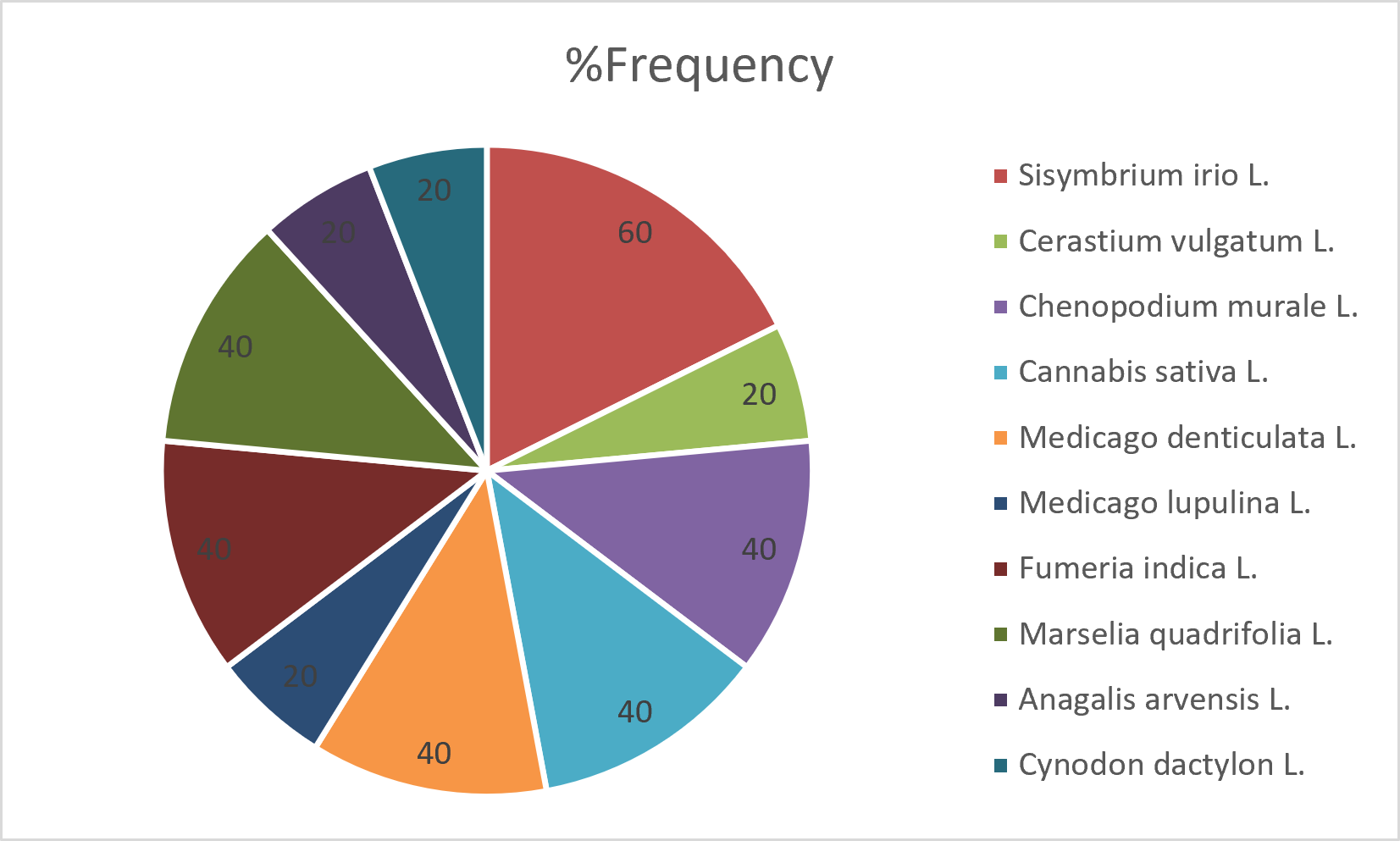
The present study was conducted to investigate the weed flora of wheat (Triticum aestivum L.) of three villages, viz Thabal, Ghazipur and Sahjowal in Tehsil Sharaqpur, Sheikhupura, Punjab, Pakistan. The quadrat of 1m square was used to investigate and to collect weed flora. The plants were collected from the studied site, dried, preserved and identified. The status of each species was determined by measuring different parameters like percent frequency, relative frequency, density, relative density, importance value, importance value index and family importance index. During the survey, 12 weed species belonging to 11 families were reported from the studied area. Out of the 11 weed families, 9 were dicots, one was monocot, and one was pteridophyte. The most important families in terms of species representation were Fabaceae with 2 species only. Amaranthaceae, Brassicaceae, Caryophyllaceae, Cannabinaceae, Fumariaceae, Primulaceae, Marsiliaceae, Primulaceae, Poaceae and Ranunculaceae were represented by only one species each. Anagallis arvensis, Coronopus didymus, Chenopodium album, Medicago lupulina, Phalaris minor, and Ranunculus bulbosus were the most dominant species. The most frequent species was Chenopodium album with 66.66% frequency, 13.33 relative frequency, and 1.46 density.
Downloads
References
Ain, Q. U., Shah, M., Ejaz, U., Jehangir, S., Ahmad, Z., Ali, S., ... & Khan, S. M. (2026). Influence of natu-ral and anthropogenic factors on weed diversity that affects the wheat crop. Agronomy Journal, 118(2), e70346.
Ali, A., Badshah, L., & Hussain, F. (2018). Vegetation structure and threats to Montane Temperate eco-systems in Hindukush Range, Swat, Pakistan. Ap-plied Ecology and Environmental Research, 16(4), 4789-4811.
Ali, H., Muhammad, Z., Khan, W. M., Jelani, G., Majeed, A., & Rehmanullah. (2018). Floristic in-ventory and ecological attributes of plant re-sources of Hazar Nao Hills, Nowshera, Pakistan. Pakistan Journal of Weed Science Research, 21(3), 417-423.
Allen, S.E. (1974). Chemical analysis of ecological ma-terial edited by Stewart. Blackwell Scientific Publi-cation, Oxford.
Badshah, L., Hussain, F., & Sher, Z. (2016). Floristic inventory, ecological characteristics and biological spectrum of plants of Parachinar, Kurram Agency, Pakistan. Pakistan Journal of Botany, 48(4), 1547-1558.
Begum, U., & Ahmad, U. (2018). Assessing Biodiver-sity and ecological attributes of different weeds in wheat crop at Kohat, Pakistan. Pakistan Journal of Weed Science Research, 24(1), 39-53.
Cottam, G., & Curtis, J.T. (1956). The Use of Distance Measures in Phytosociological Sampling. The Eco-logical Society of America, 37(3), 451-460.
Curtis, J.T. (1959). The vegetation of Wisconsin. An ordination of plant communities. University of Wisconsin Press, Madison, WI. 657.
Elangovan Vennila, E., Izquierdo, J., Medina Villar, S., & Hernández Plaza, E. (2026). Weed Diversity and Crop Performance: A Systematic Review and Me-ta‐Analysis. Weed Research, 66(4), e70105.
Frick, B. & Thomas, A. G. (1992). Weed surveys in different tillage systems in southwestern Ontario field crops. Canada Journal of Plant Science, 72, 1337-1347.
Ullah, I., Mehmood, S., Farooq, A., Ullah S. K., & Hussain, Z. (2011). Identification of common weeds and its distribution pattern in wheat fields of Bannu, Khyber Pakhtunkhwa, Pakistan. Paki-stan Journal of Weed Science Research, 17, 407-416.
Gustafsson, J., Cederberg, C., Sonesson, U., & Eman-uelsson, A. (2013). The methodology of the FAO study: Global Food Losses and Food Waste-Extent, causes and preventation-FAO, 2011: SIK Institutet for food and biotechnology.
Guneyli, E., Burniside, O. C. & Nordquist, P. T. (1969). Influence of seedling characteristics on weed competitive ability of sorghum hybrids and inbred lines. Crop Science, 9(6), 713-716.
Khan., W. (2016). Identification of different weeds and their distribution in wheat growing fields of District Abbottabad. Pakistan Journal of Weed Science, 9-16.
Khan, R. U., Mehmood, S., Khan, S. U., Muhammad, A., & Hussain, Z. (2014). Comparative study of weed species recorded in different field crops of Bannu, Khyber Pakhtunkhwa, Pakistan. Pakistan Journal of Weed Science Research, 20(4), 489-504.
Khan, M. A., Ali, K., Hussain, Z., & Afridi, R. A. (2012). Impact of maize legume intercropping on weeds and maize crop. Pakistan Journal of Weed Science Research, 8(1), 127-136.
Muhammad, S., Khan, Z., & Cheema. T. (2009). Dis-tribution of weeds in wheat, maize and potato fields of Tehsil Gojra, District Toba Tek Singh, Paki-stan. Pakistan Journal of Weed Science. Research, 15(1), 91-105.
Marwat, S. K., Uman, K., Khan, N., Khan, M. U., Khan, E. A., Khan, M. A. & Rehman, A. U. (2013). Weeds of wheat crop and their control strategies in Dera Ismail Khan District, Khyber Pakhtun Khwa, Pakistan. American Journal of Plant Sci-ence, 4, 66-76.
Monteiro, A., & Santos, S. (2022). Sustainable ap-proach to weed management: The role of preci-sion weed management. Agronomy, 12(1), 118.
Pala, F., Erman, M., Cig, F., Dilmen, H., Pala, F., Erman, M., ... & Dilmen, H. (2020). A study on weed flora and importance value index of weeds in wheat crop. International Journal of Scientific and Technological Research, 6(1), 49-59.
Perrins, J., Williamson, M., & Fitter, A. (1992). A sur-vey of differing views of weed classification: impli-cations for regulation of introductions. Biological Conservation, 60(1), 47-56.
Pott, R. (2011). Phytosociology: A modern geobo-tanical method. Plant Biosystems-An Internation-al Journal Dealing with all Aspects of Plant Biolo-gy, 145(sup1), 9-18.
Risser, P.G. and Rice, E.L. (1971). Diversity in tree species in Oklahoma upland forests. Ecology, 52, 876–880.
Shedayi, A. A., Bano, S., & IIahi, I. (2011). Weed dis-tribution in potato fields of Nazimabad, Tehsil Gojal, Gilgit-Baltistan, Pakistan. Pakistan Journal of Science Research, 17(1), 41-50.
Srivastava, R., & Singh, K. P. (2005). Species diversity in dryland and irrigated agroecosystems and mar-ginal grassland ecosystem in dry tropics. Commu-nity Ecology, 6(2), 131-141.
Tahira, J. J. & Khan, S. N. (2017). Diverisity of weed flora in onion fields of Punjab, Pakistan. Pakistan Journal of Weed Science Research, 23(2), 245-253.
Waheed, A. (2009). Weed community dynamics in wheat crop of District Rahim Yar Khan, Pakistan. Pak. J. Bot, 41(01), 247-254.
Zimdahl, R. (2007). Fundamentals of weed science. Acadamic Science, 375.
Downloads
Published
Data Availability Statement
NA
Issue
Section
License
Copyright (c) 2026 Yasir Ali Mirza, Muhammad Waheed (Author)

This work is licensed under a Creative Commons Attribution 4.0 International License.