
Effect of Indole-3-butyric acid and Jasmonic acid on rooting ability of Dombeya wallichii (Lindl.) Benth. & Hook. fil
DOI:
https://doi.org/10.9200/z00kqd03Keywords:
Dombeya wallichii, Growth, Indole-3-butyric acid, Jasmonic Acid, Rooting of cuttingsAbstract
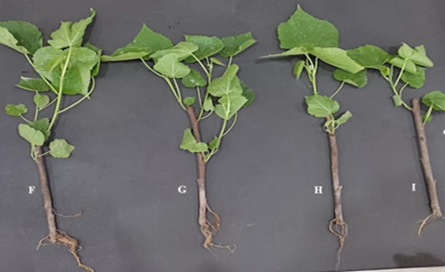
This study aimed to investigate the role of plant growth regulators indole-3-butyric acid (IBA) and Jasmonic acid (JA) on the rooting of stem cuttings of Dombeya wallichii, popular for their aesthetic and medicinal purposes. The semi-hardwood cuttings were treated with different concentrations of the IBA (10, 20 µM) and/or JA (5, 10 µM) alone or in combinations. The control cuttings were simultaneously treated with water and planted in plastic pots filled with an equal proportion of soil and compost. The results of the experiment suggested that all morphological parameters of the plant did not respond when treated with IBA and JA alone. The maximum increase in all parameters such as highest number of buds (12), leaf length (6.7 cm), leaf width (6.6 cm), number of leaves (14), number of branches (15), shoot length (23 cm), root length (10 cm), fresh weight of shoot (16.3 g), dry weight of shoot (4.6 g), fresh weight of root (2.05 g) and dry weight of root (1.57 g) was recorded when IBA and JA used in combination (10 µM IBA and 5 µM JA). The vigor and survival of the rooted cuttings were optimized and consistent. So, the present research work demonstrated an efficient method for the mass production of plants through vegetatively rooted cuttings to meet the market demands.
Downloads
References
Abu-Zahra, T. R., Hasan, M. K., & Hasan, H. S. (2012). Effect of different auxin concentration on virgin-ia creeper (Parthenocissus quinquefolia) root-ing. World Applied Sciences Journal, 16(1), 7-10.
Akhtar, G., Akram, A., Sajjad, Y., Balal, R. M., Shahid, M. A., Sardar, H., & Shah, S.M. (2015). Potential of plant growth regulators on modulating root-ing of Rosa centifolia. American Journal of Plant Sciences, 6(05), 659.
Ali, H., Hussain, I., Ali, K., Noor, S., Imtiaz, A., Zee-shan, M., … Sarwar, S. (2024). Effects of growth regulator on invitro propagation of lilium using bulb scale. Pakistan Journal of Biotechnology, 21(2), 339–344. https://doi.org/10.34016/pjbt.2024.21.02.927
Aremu, A. O., & Pendota, S. C. (2021). Medicinal plants for mitigating pain and inflammatory-related conditions: an appraisal of ethnobotani-cal uses and patterns in South Africa. Frontiers in Pharmacology, 12, 758583.
Ashrafuzzaman, M., & Sarwar, A. K. M. (2021). Spe-cies diversity of Sterculiaceae at Bangladesh Ag-ricultural University Botanical Garden and their ethnobotanical uses. Asian Journal of Research in Botany, 5(4), 1-8.
Awotedu, B. F., Omolola, T. O., Akala, A. O., Awotedu, O. L., & Olaoti-Laaro, S. O. (2021). Vegetative propagation: A unique technique of improving plants growth. World News of Natu-ral Sciences, 35, 83-101.
Bhandari, A. J., Patel, R. B., Chawla, S. L., Pavagadhi, D. C., & Patel, B. B. (2015). Effect of plant growth regulators (PGR'S) on vegetative propa-gation of Hibiscus rosa-sinensis L. BIOINFOLET-A Quarterly Journal of Life Sciences, 12(1a), 121-124.
Bożek, M., Denisow, B., Strzałkowska-Abramek, M., Chrzanowska, E., & Winiarczyk, K. (2023). Non-forest woody vegetation: a critical resource for pollinators in agricultural landscapes. Sustaina-bility, 15(11), 8751.
Cai, K., Zhang, D., Li, X., Zhang, Q., Jiang, L., Li, Y., & Zhao, X. (2023). Exogenous phytohormone ap-plication and transcriptome analysis provides in-sights for adventitious root formation in Taxus cuspidata. Plant Growth Regulation, 100(1), 33-53.
Chen, H., Lei, Y., Sun, J., Ma, M., Deng, P., Quan, J. E., & Bi, H. (2023). Effects of Different Growth Hormones on Rooting and Endogenous Hor-mone Content of Two Morus alba L. Cuttings. Horticulturae, 9(5), 552.
Druege, U., Franken, P., & Hajirezaei, M. R. (2016). Plant hormone homeostasis, signaling, and function during adventitious root formation in cuttings. Frontiers in Plant Science, 7, 186360.
Elmongy, M. S., Cao, Y., Zhou, H., & Xia, Y. (2018). Root development enhanced by using Indole-3-Butyric Acid and Naphthalene Acetic Acid and associated biochemical changes of in vitro Azal-ea microshoots. Journal of Plant Growth Regula-tion, 37, 813-825.
Fattorini, L., Falasca, G., Kevers, C., Mainero Rocca, L., Zadra, C., & Altamura, M. M. (2009). Adven-titious rooting is enhanced by methyl jasmonate in tobacco thin cell layers. Planta, 231, 155-168.
Fu, J., Liu, L., Liu, Q., Shen, Q., Wang, C., Yang, P., ... & Wang, Q. (2020). ZmMYC2 exhibits diverse functions and enhances JA signaling in transgen-ic Arabidopsis. Plant cell reports, 39, 273-288.
Ganesh, J., Hewitt, K., Devkota, A. R., Wilson, T., & Kaundal, A. (2024). IAA- producing plant growth promoting rhizobacteria from Ceano-thus velutinus enhance cutting propagation effi-ciency and Arabidopsis biomass. Frontiers in Plant Science, 15, 1374877.
Ghimire, B. K., Kim, S. H., Yu, C. Y., & Chung, I. M. (2022). Biochemical and physiological changes during early adventitious Root formation in Chrysanthemum indicum Linné Cuttings. Plants, 11(11), 1440.
Gonin, M., Bergougnoux, V., Nguyen, T. D., Gantet, P., & Champion, A. (2019). What makes adven-titious roots? Plants, 8(7), 240.
Guchhait, P., Varma, S., Banerjee, D., Kumar, S., Hal-der, R., & Dahiya, A. (2024). Plant growth regu-lators and rooting media: A viable approach for growth and performance of citrus. Journal of Experimental Agriculture International, 46(5), 366-378.
Gutierrez, L., Mongelard, G., Floková, K., Păcurar, D. I., Novák, O., Staswick, P., & Bellini, C. (2012). Auxin controls Arabidopsis adventitious root ini-tiation by regulating Jasmonic acid homeostasis. The Plant Cell, 24(6), 2515-2527.
Havens, K., Kramer, A. T., & Guerrant Jr, E. O. (2014). Getting plant conservation right (or not): the case of the United States. International Journal of Plant Sciences, 175(1), 3-10.
Hou, P. C., Lin, K. H., Huang, Y. J., Wu, C. W., & Chang, Y. S. (2020). Evaluation of vegetation in-dices and plant growth regulator use on the rooting of azalea cuttings. Horticultural Brasilei-ra, 38, 153-159.
Idowu, D. O., Aiyelaagbe, O. O., & Idowu, P. A. (2023). Chemical composition and biological ac-tivities of volatile oil of the stem of Dombeya buettneri K. Schum. (Sterculiaceae). Scientific African, 20, e01624.
Ju, J., Xie, Y., Yu, H., Guo, Y., Cheng, Y., Qian, H., & Yao, W. (2022). Synergistic interactions of plant essential oils with antimicrobial agents: A new antimicrobial therapy. Critical Reviews in Food Science and Nutrition, 62(7), 1740-1751.
Judd, L. A., Jackson, B. E., & Fonteno, W. C. (2015). Advancements in root growth measurement technologies and observation capabilities for container-grown plants. Plants, 4(3), 369-392.
Kashyap, U., Chandel, A., Sharma, D., Bhardwaj, S., & Bhargava, B. (2021). Propagation of Jas-minum parkeri: A critically endangered wild or-namental woody shrub from Western Himalaya. Agronomy, 11(2), 331.
Kaushik, S., & Shukla, N. (2020). A review on effect of IBA and NAA and their combination on the rooting of stem cuttings of different ornamental crops. Journal of Pharmacognosy and Phyto-chemistry, 9(3), 1881-1885.
Kazeem, M. I., & Tom Ashafa, A. O. (2016). Antioxi-dant and inhibitory properties of Dombeya bur-gessiae leaf extracts on enzymes linked to diabe-tes mellitus. Transactions of the Royal Society of South Africa, 71(2), 167-174.
Khan, F. S., Goher, F., Paulsmeyer, M. N., Hu, C. G., & Zhang, J. Z. (2023). Calcium (Ca2+) sensors and MYC2 are crucial players during jasmonates‐mediated abiotic stress tolerance in plants. Plant Biology, 25(7), 1025-1034.
Kumar, A., Choudhary, A., Kaur, H., Sangeetha, K., Mehta, S., & Husen, A. (2022). Physiological and environmental control of adventitious root for-mation in cuttings. Frontiers in Plant Science, 7(6), 1-24.
Li, S. W. (2021). Molecular bases for the regulation of adventitious root generation in plants. Frontiers in Plant Science, 12, 614072.
Lischweski, S., Muchow, A., Guthörl, D., & Hause, B. (2015). Jasmonates act positively in adventi-tious root formation in petunia cuttings. BMC plant biology, 15, 1-10.
Liu, G., Zhao, J., Liao, T., Wang, Y., Guo, L., Yao, Y., & Cao, J. (2021). Histological dissection of cutting-inducible adventitious rooting in Platycladus ori-entalis reveals developmental endogenous hor-monal homeostasis. Industrial Crops and Prod-ucts, 170, 113817.
Masoko, P., Matotoka, M. M., & Mphosi, M. S. (2022). Phytochemical analysis and antibacterial activity of Citrullus lanatus var. citroides (Citron watermelon) fruit and the effect of temperature on the biological activity of the rind. South Afri-can Journal of Botany, 150, 1111-1121.
Mazzoni-Putman, S. M., Brumos, J., Zhao, C., Alonso, J. M., & Stepanova, A. N. (2021). Auxin interactions with other hormones in plant de-velopment. Cold Spring Harbor Perspectives in Biology, 13(10), a039990.
Megersa, H. G. (2017). Propagation methods of se-lected horticultural crops by specialized organs. Journal of Horticulture, 4(02).
Mehta, S. K., Singh, K. K., & Harsana, A. S. (2018). Effect of IBA concentration and time of planting on rooting in pomegranate (Punica granatum) cuttings. Journal of Medicinal Plants Studies, 6(1), 250-253.
Naji, D. A., Attiya, H. J., & Askar, H. M. (2015). Effect of plant growth regulators (IBA, BA, and CCC) on some vegetative characters of three hybrid lily cultivars of (Lilium spp. L.). Iraqi Journal of Science, 56(2A), 972-982.
Olatunji, D., Geelen, D., & Verstraeten, I. (2017). Control of endogenous auxin levels in plant root development. International Journal of Molecular Sciences, 18(12), 2587.
Olawuwo, O. S., Famuyide, I. M., & McGaw, L. J. (2022). Antibacterial and antibiofilm activity of selected medicinal plant leaf extracts against pathogens implicated in poultry diseases. Fron-tiers in veterinary science, 9, 820304.
Oseni, O. M., Pande, V., & Nailwal, T. K. (2018). A review on plant tissue culture, a technique for propagation and conservation of endangered plant species. International Journal of Current Microbiology and Applied Sciences, 7(7), 3778-3786.
Pamfil, D., & Bellini, C. (2011). Auxin control in the formation of adventitious roots. Notulae Botan-icae. Horti Agrobotanici Cluj-Napoca, 39(1), 307-316.
Paul, S. (2011) Trachyspermum ammi (L.) fruit es-sential oil influencing on membrane permeability and surface inhibiting food –borne pathogens. Food Control, 22. 725 – 6.
Pincelli-Souza, R. P., Tang, Q., Miller, B. M., & Cohen, J. D. (2024). Horticultural potential of chemical biology to improve adventitious rooting. Horti-culture Advances, 2(1), 1-25.
Puentes, S. M., Lopez, J. C., Galhardo, D., Oliveira, J. W., & de Toledo, V. A. A. (2019). Foraging be-haviour of Apis mellifera L. and Scaptotrigona bipunctata
on D. wallichiiflowers in southern Brazil. Agricultural Science, 45, 108085.
Ranjbar, A., & Ahmadi, N. (2016). The effects of IBA and NAA, and rooting media on propagation of miniature rose cuttings (Rosa hybrida). Journal Of Horticultural Science, 30(3), 520-528.
Rasmussen, A., Hosseini, S. A., Hajirezaei, M. R., Druege, U., & Geelen, D. (2015). Adventitious rooting declines with the vegetative to repro-ductive switch and involves a changed auxin homeostasis. Journal of Experimental Botany, 66(5), 1437-1452.
Rifnas, L. M., Vidanapathirana, N. P., Silva, T. D., Da-hanayake, N., Subasinghe, S., Weerasinghe, S. S., & Madushani, W. G. C. (2023). Development of Cutting Propagation Technique for Ornamen-tal Plant Allamanda cathartica (Rukkathana). Journal of Agro-Technology and Rural Sciences, 3(1), 28-33.
Roberto, S. R., & Colombo, R. C. (2020). Innovation in propagation of fruit, vegetable and ornamen-tal plants. Horticulturae, 6(2), 23.
Rocha, J.F. (2010) Anatomy e Histochemistry of the Floral Nectaries of D. wallichii(Lindl.) K. Schum. and Dombeya natalensis Sond. (Malvaceae). Re-vista de Biologia Neotropical, 7, 27-36.
Ruan, J., Zhou, Y., Zhou, M., Yan, J., Khurshid, M., Weng, W., ... & Zhang, K. (2019). Jasmonic acid signaling pathway in plants. International jour-nal of molecular sciences, 20(10), 2479.
Sandhya, S., Mehta, S., Pandey, S., & Husen, A. (2022). Adventitious root formation in cuttings as influenced by genotypes, leaf area, and types of cuttings. Frontiers in Plant Science,33(4), 842469.
Shinde, M. B., Rathod, N. G., Gupta, N. S., Deshmukh, M. S., & Uphade, C. V. (2022). Ef-fect of growth regulators on sprouting and root-ing of Bougainvillea hardwood cuttings. The Pharma Innovation Journal, 11(1), 846-850.
Singh, B., Sindhu, S. S., Yadav, H., & Saxena, N. K. (2017). Influence of growth hormones on hardwood cutting of Bougainvillea cv. Dr HB Singh. Chemical Science Review and Letter 6(23), 1903-1907.
Skema, C. (2014). Re-evaluation of species delimita-tions in Dombeya section Hilsenbergia (Dombeyaceae). Systematic Botany, 39(2), 541-562.
Sohn, S. I., Pandian, S., Rakkammal, K., Largia, M. J. V., Thamilarasan, S. K., Balaji, S., & Ramesh, M. (2022). Jasmonates in plant growth and devel-opment and elicitation of secondary metabo-lites. Frontiers in Plant Science, 13, 942789.
Solgi, M., Taghizadeh, M., and Bagheri, H. (2022). Response of black mulberry onto white mulber-ry rootstock to stenting (cutting grafting) tech-niques and IBA concentrations. Ornamental Horticulture. 28, 78–84.
Soliman, W. S., Saad-Eldeen, K., & Gahory, A. A. (2023). An Investigation of Indole Butyric Acid Effects on Growth and Development of Dwarf Bougainvillea. Aswan University Journal of Sci-ences and Technology, 3(1), 154-163.
Sultana, Z., Akand, M. S. H., Patwary, N. H., Mahbu-ba, M., Authors, K., & Amin, M. R. (2016). Root-ing performance of stem cuttings of three or-namental plants as influenced by growth regula-tors. International Journal of Natural and Social Sciences, 3(2), 38-45.
Sundararajan, S., Sivakumar, H. P., Rajendran, V., Kumariah, M., & Ramalingam, S. (2023). Adven-titious roots in rice, the model cereal: genetic factors and the influence of environmental cues—a mini review. Plant Cell, Tissue and Or-gan Culture, 154(1), 1-12.
Tangjitman, K., Wongsawad, C., Kamwong, K., Suk-kho, T., & Trisonthi, C. (2015). Ethnomedicinal plants used for digestive system disorders by the Karen of northern Thailand. Journal of Eth-nobiology and Ethnomedicine, 11, 1-13.
Tropical Plants Database, Ken Fern. tropi-cal.theferns.info. 2026-05-07.
Vielba, J. M., Vidal, N., José, M. C. S., Rico, S., & Sánchez, C. (2020). Recent advances in adventi-tious root formation in chestnut. Plants, 9(11), 1543.
Wang, M., Xiao, J., Wei, H., & Jeong, B. R. (2020). Supplementary light source affects growth and development of carnation ‘Dreambyul’cuttings. Agronomy, 10(8), 1217.
Wang, Y., Mostafa, S., Zeng, W., & Jin, B. (2021). Function and mechanism of Jasmonic acid in plant responses to abiotic and biotic stresses. In-ternational Journal of Molecular Sciences, 22(16), 8568.
Winkelmann, T. (2012, July). Recent advances in propagation of woody plants. II International Symposium on Woody Ornamentals of the Temperate Zone, 990 (375-381).
Xu, P., Zhao, P. X., Cai, X. T., Mao, J. L., Miao, Z. Q., & Xiang, C. B. (2020).
Integration of jasmonic acid and ethylene into auxin signaling in root development. Frontiers in Plant Science, 11, 519782.
Zhang, Y., Li, Y., Hassan, M. J., Li, Z., & Peng, Y. (2020). Indole-3-acetic acid improves drought tolerance of white clover via activating auxin, abscisic acid and jasmonic acid related genes and inhibiting senescence genes. BMC Plant Biology, 20, 1-12.
Additional Files
Published
Issue
Section
License
Copyright (c) 2026 Sania Sadiq, Sheza Ayaz Khilji (Author)

This work is licensed under a Creative Commons Attribution 4.0 International License.