
Estimation of carbon level along the canal bank roadside of some selected tree species from Faiz Ahmad Faiz underpass to Thokar Niaz Baig flyover, Lahore
DOI:
https://doi.org/10.9200/54f2jx85Keywords:
Canal bank, Climate change, Carbon biomass, Family Myrtaceae, Flyover, Lahore underpassAbstract
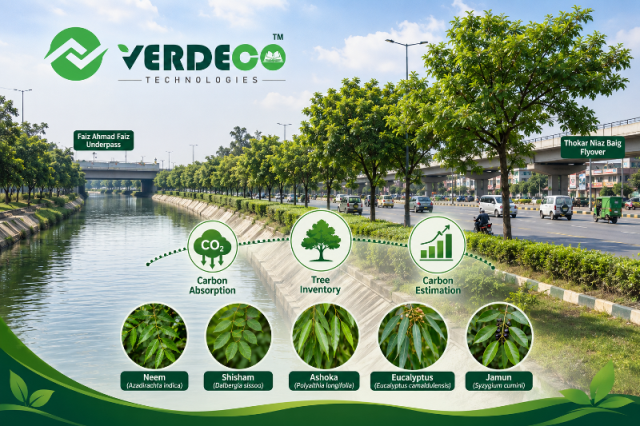
The climate change effects the world disastrously and the temperature of earth is rising day by day due to accumulation of greenhouse gases. By considering global warming and its effects, the present research work was carried out in order to estimate the carbon stock of some selected tree species along Canal Bank Road Lahore from Faiz Ahmed Faiz Underpass to Thokar Niaz Baig Flyover. The road-side vegetation along Canal Bank Road is distributed into four green belts where abundantly 24 tree species of 12 families were recorded. Syzygium cumini L. was dominated by 1224 plants followed by Dalbergia sissoo DC. and Eucalyptus citriodora Hook. having 671 and 550 trees, respectively. The total estimated carbon stock of trees was 32616.1 kg and 8992.935 kg to roadsides. In terms of an overall carbon sequestration potential, 122367.5 kg was total estimated biomass of all selected trees species present in four green belts of Canal Bank Road and the total carbon stock of all selected species on Canal Bank Road was 61183.74 kg. Moreover, the carbon stock of Family Myrtaceae was 24011.725 kg, followed by Fabaceae (13704.365 kg), Moraceae (9986.49 kg), Malvaceae (4170.64 kg), Bignoniaceae (3164.4 kg), Anacardiaceae (3034.55 kg) and Combretaceae (1419.4 kg). Dalbergia sissoo (10159.5 kg), Eucalyptus citrodora (9529.1 1 kg) and Syzygium cumini (8057. 12 kg) were the richest in number and have greatest potential to sequester carbon dioxide from atmosphere of Canal Bank Road Lahore.
Downloads
References
Agbelade, A. D., Onyekwelu, J. C., & Oyun, M. B. (2016). Tree Species Diversity and their Benefits in Urban and Peri-Urban Areas of Abuja and Minna, Nigeria. Applied Tropical Agriculture, 21 (3), 27-36.
Akbari, H., Pomerantz, M., & Taha, H. (2001). Cool surfaces and shade trees to reduce energy use and improve air quality in urban areas. Solar Energy, 70(3), 295-310.
Ali, A., Ashraf, M. I., Gulzar, S., & Akmal, M. (2020). Urban forestry and ecosystem services in Paki-stan: Challenges and opportunities.
Ali, M. (2013). Effects of Climate Change on Vegeta-tion. In: Climate Change Impacts on Plant Bio-mass Growth. Springer, Dordrecht, Pp 111-113.
Anil, R., & Krishna, K. C. (2020). Tree species suitable for roadside afforestation and carbon seques-tration in Bilaspur, India. Carbon Management, 11:4, 369-380.
Bhatta, S. P., Sharma, K. P., & Balami, S. (2018). Vari-ation in carbon storage among tree species in the planted forest of Kathmandu, Central Ne-pal. Current Science, 1 15(2), 274-282.
Birdsey, R. A. (1992). Carbon Storage and Accumula-tion in United State Forest Ecosystem, General Technical Report WO-59. Northeastern Forest Experiment Station. United State Department of Agriculture Forest Service, pp51.
Brown, S. (1997). Estimating biomass and biomass change of tropical forests: a primer. Rome, Ita-ly. FAO, Forestry Paper-134, pp 165.
Cairns, M. A., Brown, S., Helmer, E. H., & Baumgard-ner, G. A. (1997). Root biomass allocation in the world's upland forests. Qecologia, 111, 1-11.
Chavan, B. L, & Rasal, G. B. (2011). Sequestered car-bon potential and status of eucalyptus tree. In-ternational Journal of Applied Engineering and Technology, 1(1), 41-47.
Chavan, B. L., & Rasal, G. B. (2010). Sequestered standing carbon stock in selective tree species grown in University Campus at Aurangabad, Maharashtra, India. International Journal of En-gineering Science and Technology, 2(7), 3003-3007.
Chavan, B., & Rasal, G. (2012). Total sequestered carbon stock of Mangifera indica. J Environ Earth Sci, 2(1).
Dewald, S., Josiah, S., & Erdkamp, B. (2005). Heating with wood; Producing, Harvesting and pro-cessing firewood. Institute of Agriculture and National Resources, University of Nebraska.
FAO. (2007). Adaptation to climate change in agricul-ture, forestry and fisheries: Perspective, framework and priorities. Food and Agriculture Organization of the United Nations, Rome, Ita-ly, pp 32.
Frantzeskaki, N. (2019). Seven lessons for planning nature-based solutions in cities. Environmental Science Policy, 93, 101-111.
Gibbs, H. K., Brown, S., Niles, J. O., Jonathan, A., & Foley, J. A. (2007). Monitoring and estimating tropical forest carbon stocks: making REDD a reality. Environmental Research Letters, 2 (4), 1-13.
Hangarge, L. M., Kulkarni, D. K., Gaikwad, V. B., Ma-hajan, D. M., & Chaudhari, N. (2012) Carbon se-questration potential of tree species in Somjaichi Rai (Sacred grove) at Nandghur vil-lage, in Bhor region of Pune District, Maharash-tra State, India. Annals of Biological Research, 3(7), 3426-3429.
Hass, A. L., Ellis, K. N., Reyes Mason, L., Hathaway, J. M., & Howe, D. A. (2016). Heat and humidity in the city: neighborhood heat index variability in a mid-sized city in the southeastern United States. International journal of environmental research and public health, 13(1), 117.
Ifeanyi-obi, C. C., Etuk, U. R., & Jike-wai, O. (2012). Climate Change, Effects and Adaptation Strate-gies; Implication for agricultural extension sys-tem in Nigeria. Greener Journal of Agricultural Sciences, 2(2), 53-60.
Jenkins, J. C., Chojnacky, D. C., Heath, L. S., & Bird-sey, R. A. (2003). National-scale biomass esti-mators for United States tree species. Forest Science, 49, 12-35.
Kabisch, N. (2015). Ecosystem service implementa-tion and governance challenges in urban green space planning-The case of Berlin, Germany. Land Use Policy, 42, 557-567.
Lafortezza, R, Chen, J., Bosch, C. K., & Thomas, B. R. (2018). Nature-based solutions for resilient landscapes and cities. Environmental Research, 165, 431-441.
McPherson, E. G, Nowak, D., Heisler, G., Grimmond, S., Souch, C., Grant, R., & Rowntree, R. (1997). Quantifying urban forest structure, function and value: the Chicago Urban Forest Climate Project. Urban Ecosystems, 1, 49-61.
Mullaer-Dombois, D., & Ellenberg, N. (1974). Aims and Methods of Vegetation Ecology. John Wiley & Sons, New York. Pp. 74.
Nagendra, H., & Gopal, D. (2010). Street trees in Bangalore: Density, diversity, composition and distribution, Urban Forest Urban Greening 9, 129-137.
Nero, B.. Callo-Concha, D., Anning, A., & Denich, M. (2017). Urban Green Spaces Enhance Climate Change Mitigation in Cities of the Global South: The Case of Kumasi, Ghana Procedia Engineer-ing, 198, 69-83.
Nesshöver, C., Assmuth, T., Irvine, K. N., Rusch, G. M., Waylen, K. A., Delbaere, B., & Krauze, K. (2017). The science, p policy and practice of na-ture-based solutions: An interdisciplinary per-spective. Science Total Environment, 579, 1215-1227.
Novara, A., Pulido, M., Rodrigo-Comino, J., Prima, S.D., Smith, P., Gristina, A., Gimenez-Morera, Terol, E., Salesa D., & Keesstra, S. (2019). Long-term organic farming on a citrus plantation re-sult in soil organic matter recovery. Cuadernos De Investigacion Geográfica, 45, 271-286.
Nowak, D. J., && Crane, D. E. (2002). Carbon storage and sequestration by urban trees in the USA. Environmental Pollution, 1 16, 381-389.
Nowak, D. J., Crane, D. E., Stevens, J. C., Hoehn, R. E., Walton, J. T., & Bond, J. (2008). A Ground- Based Method of Assessing Urban Forest Struc-ture and Ecosystem Services. Arboric Urban Forest, 34, 347-358.
Paladinic, E, Vuletic, D., Martinic, I., Marjanovic, H., Indir, K., Benko, M., && Novotny, V. (2009). Forest biomass and sequestered carbon esti-mation according to main tree components on the forest stand scale. Periodicum Biologorum, 111(4), 459-466.
Roy, S., Byrne, J., & Pickering, C. (2012). A systematic quantitative review of urban tree benefits, costs and assessment methods across cities in different climatic zones. Urban Forestry & Ur-ban Greening, 11(4), 351–363.
Rumi, Raza (2008). '"On Lahore's canal | Lahore Na-ma"
Schroeder, P. (1992). Carbon storage potential of short-rotation tropical tree plantations. Forest Ecology and Management, 50(1-2): 31-41.
Syafinie, A. M., & Ainuddin, N. A. (2015), Ab0vegroun d biomass and carbon stock esti-mation m logged-over lowland tropical forest in Malaysia. International Journal of Agricultural, Forestry& Plantation, 1, 1-14.
Tak, A. A., & Kakde, U. B. (2020). Analysis of carbon sequestration by dominant trees in urban areas of Thane city. International Journal of Global Warming, 20 (1), 1-13.
Vashum, K.T, & Jayakumar, S. (2012). Methods to estimate above-ground biomass and carbon stock in natural forests - a review. Journal of Ecosystem & Ecography, 2 (4).
Walker, A. P., De Kauwe, M. G., Bastos, A., Bel-mecheri, S., Georgiou, K., Keeling, R. F. & Zuidema, P. A. (2021). Integrating the evidence for a terrestrial carbon sink caused by increasing atmospheric CO2. New Phytologist, 229(5), 2413-2445.
Warrick, R. A., & Barrow, E. M. (1991). Climate change scenarios for the UK. Transactions of the Institute of British Geographers, 16, 387-399.
Downloads
Published
Issue
Section
License
Copyright (c) 2026 Muzammal Munir, Muhammad Waheed (Author)

This work is licensed under a Creative Commons Attribution 4.0 International License.