
Rooting of stem cuttings of Salix babylonica L. using indole-3-butyric acid
Keywords:
Indole-3 butyric acid, Rooting Efficacy, Salix babylonicaAbstract
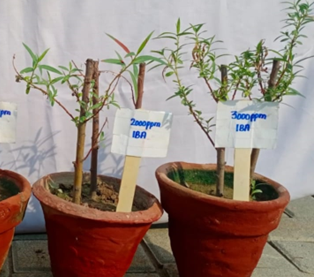
Salix babylonica L. is a native plant to temperate cold climates around the northern hemisphere. It is used in medicines, crafts and as building material. Salicin - a source of salicylic acid used in pain relieving medicine is derived from the bark of Salix tree. Seeds of Salix babylonica L. are unviable with low germination rate. Therefore, the method of vegetative propagation is recommended. Present work was designed to vegetatively propagate Salix babylonica L. through its stem cuttings. Different concentrations of indole-3-butyric acid (1000, 2000, 3000 ppm) were used as the rooting agent with five replicates of each treatment in this experiment. The experiment was performed in completely randomized design. Observations were made on the 15th, 30th, and 60th day of the experiment and data were recorded for the parameters like number of shoots, shoot length, number of leaves and roots and root length. The statistical analysis of data obtained by application of IBA indicated that IBA played a pivotal role in the response of nearly all the parameters. It significantly increased all the parameters like number of shoots, shoot length, number of leaves and roots and root length. The observations recorded at three intervals of the experiment (15th, 30th, and 60th days) revealed the same trend: a significant increase in all the parameters studied.
Downloads
References
Abhijeet, R., & Mokat, D. (2018). On vegetative propagation through stem cuttings in medicinally lucrative Tinospora species. Journal of Pharmacognosy and Phytochemistry, 7(2), 2313-2318.
Acha, I. A., Shiwachi, H., Asiedu, R., & Akoroda, M. O. (2004). Effect of auxins on root development in yam (Dioscorea rotundata) vine. Tropical science, 44(2), 80-84.
Al-Saqri, F., & Alderson, P. G. (1996). Effects of IBA, cutting type and rooting media on rooting of Rosa centifolia. Journal of Horticultural Science, 71(5), 729-737.
Aminah, H., Dick, J. M., Leakey, R. R. B., Grace, J., & Smith, R. I. (1995). Effect of indole butyric acid (IBA) on stem cuttings of Shorea leprosula. Forest Ecology and Management, 72(2-3), 199-206.
Babu, B. H., Amit, L., & Hemant, K. (2019). To evaluate the effect of auxin concentrations (IBA and IAA) on survival percentage of stem cuttings of species Terminalia chebula (Retz.). Indian Forester, 145(4), 333-338.
Bachelard, E. P., & Stowe, B. B. (1963). Rooting of Cuttings of Acer Rubrum l. And Eucalyptus Camaldulensis Dehn. Australian Journal of Biological Sciences, 16(4), 751-767.
Borowski, E., Kozłowska, L., & Wilkowicz, M. (1986). The effect of indole-butyric acid and kinetin on rooting of rose cuttings in winter and summer. Acta agrobotanica, 39(1), 47-57.
Budde, K. B., Gallo, L., Marchelli, P., Mosner, E., Liepelt, S., Ziegenhagen, B., & Leyer, I. (2011). Wide spread invasion without sexual reproduction? A case study on European willows in Patagonia, Argentina. Biological Invasions, 13, 45-54.
Capuana, M., Nissim, W. G., & Klein, J. D. (2022). Protocol for In Vitro Propagation of Salix acmophylla (Boiss.). Studies on Three Ecotypes. Forests, 13(7), 1124.
Cogliastro, A., Domon, G., & Daigle, S. (2001). Effects of wastewater sludge and woodchip combinations on soil properties and growth of planted hardwood trees and willows on a restored site. Ecological Engineering, 16(4), 471-485.
Courchesne, F., Turmel, M. C., Cloutier-Hurteau, B., Constantineau, S., Munro, L., & Labrecque, M. (2017). Phytoextraction of soil trace elements by willow during a phytoremediation trial in Southern Québec, Canada. International journal of phytoremediation, 19(6), 545-554.
Doty, S. L. (2008). Enhancing phytoremediation through the use of transgenics and endophytes. New Phytologist, 179(2), 318-333.
Durak, A., Gawlik-Dziki, U., & Sugier, D. (2015). Coffee enriched with willow (Salix purpurea and Salix myrsinifolia) bark preparation–Interactions of antioxidative phytochemicals in a model system. Journal of functional foods, 18, 1106-1116.
El-Shemy, H. A., Aboul-Enein, A. M., Aboul-Enein, K. M., & Fujita, K. (2007). Willow leaves' extracts contain anti-tumor agents effective against three cell types. PLOS One, 2(1), e178.
Ezekiel, A. (2010). Viable options and factors in consideration for low-cost vegetative propagation of tropical trees. International Journal of Botany, 6(2), 187-193.
Fortin Faubert, M., Desjardins, D., Hijri, M., & Labrecque, M. (2021). Willows used for phytoremediation increased organic contaminant concentrations in soil surface. Applied Sciences, 11(7), 2979.
Frick, E. M., & Strader, L. C. (2018). Roles for IBA-derived auxin in plant development. Journal of Experimental Botany, 69(2), 169-177.
Gaspar, T., Kevers, C., Penel, C., Greppin, H., Reid, D. M., & Thorpe, T. A. (1996). Plant hormones and plant growth regulators in plant tissue culture. In vitro Cellular & Developmental Biology-Plant, 32, 272-289.
Islam, M. S., Zahan, R., Nahar, L., Alam, M. B., Naznin, M., Sarkar, G. C., & Haque, M. E. (2011). Antibacterial, insecticidal and in vivo cytotoxicity activities of Salix tetrasperma. International Journal of Pharmaceutical Sciences and Research, 2(8), 2103.
Jama, A., & Nowak, W. (2012). Willow (Salix viminalis L.) in purifying sewage sludge treated soils. Polish Journal of Agronomy, 9, 3-6.
Jamal, A., Ayub, G., Ali Rahman, A. R., Ali, J., & Shahab, M. (2021). 08. Effect of IBA (Indole Butyric Acid) levels on the growth and rooting of different cutting types of Clerodendrum splendens. Pure and Applied Biology (PAB), 5(1), 64-71
Jankovska-Bortkevič, E., Katerova, Z., Todorova, D., Jankauskienė, J., Mockevičiūtė, R., Sergiev, I., & Jurkonienė, S. (2023). Effects of Auxin-Type Plant Growth Regulators and Cold Stress on the Endogenous Polyamines in Pea Plants. Horticulturae, 9(2), 244.
Junior, E. E. E., Gusua, C. R., Tchapda, T. D., & Andre, O. N. P. (2017). Vegetative propagation of selected clones of cocoa (Theobroma cacao L.) by stem cuttings. Journal of Horticulture and Forestry, 9(9), 80-90.
Liesebach, M., & Naujoks, G. (2004). Approaches on vegetative propagation of difficult-to-root Salix caprea. Plant Cell, Tissue and Organ Culture, 79 (2), 239-247.
Llanes, A., Reginato, M., Devinar, G., & Luna, V. (2018). What is known about phytohormones in halophytes? A review. Biologia, 73, 727-742.
Luna, T. (2009). Vegetative propagation. Nursery manual for native plants: A guide for tribal nurseries, 1, 153-175.
Mahdi, J. G. (2010). Medicinal potential of willow: A chemical perspective of aspirin discovery. Journal of Saudi Chemical Society, 14(3), 317-322.
Majeed, M., Khan, M. A., & Mughal, A. H. (2009). Vegetative propagation of Aesculus indica through stem cuttings treated with plant growth regulators. Journal of Forestry Research, 20, 171-173.
Mostafa, I., Abbas, H. A., Ashour, M. L., Yasri, A., El-Shazly, A. M., Wink, M., & Sobeh, M. (2020). Polyphenols from Salix tetrasperma impair virulence and inhibit quorum sensing of Pseudomonas aeruginosa. Molecules, 25(6), 1341.
Nanda, I. P., & Meerambika, M. (2010). Effect of IBA and NAA on rooting in stem cutting of Hibiscus rosa-sinensis L. Advances in Plant Sciences, 23(2), 513-514.
Naujoks, G. (2007). Micropropagation of Salix caprea L. Protocols for micropropagation of woody trees and fruits, 213-220.
Neuner, H., & Beiderbeck, R. (1993). In vitro propagation of Salix caprea L. by single node explants. Silvae genetica, 42, 308-308.
Nissim, W. G., & Labrecque, M. (2016). Planting microcuttings: An innovative method for establishing a willow vegetation cover. Ecological Engineering, 91, 472-476
Noleto-Dias, C., Ward, J. L., Bellisai, A., Lomax, C., & Beale, M. H. (2018). Salicin-7-sulfate: A new salicinoid from willow and implications for herbal medicine. Fitoterapia, 127, 166-172.
Pal, S. L. (2019). Role of plant growth regulators in floriculture: An overview. Journal of Pharmacognosy and Phytochemistry, 8(3), 789-796.,
Pervaiz, S., Beigh, M. A., Lone, R. A., & Nanda, A. B. (2007). Effect of plant growth regulators on rooting of Barbados cherry. Asian Journal of Horticulture, 2(1), 152-154.
Pierik, R. L. M., & Pierik, R. L. M. (1997). Vegetative propagation. In vitro Culture of Higher Plants, 183-230.
Pupo, J. J. S., Alarcón, R. P., Carrasco, Y. F., & Rodríguez, S. R. (2020). In vitro propagation of salix babylonica L. from nodal segments. Revista Cubana de Ciencias Forestales, 8(3), 410-424
Quan, J. E., Ni, R., Wang, Y., Sun, J., Ma, M., & Bi, H. (2022). Effects of different growth regulators on the rooting of Catalpa bignonioides softwood cuttings. Life, 12(8), 1231.
Rademacher, W. (2015). Plant growth regulators: backgrounds and uses in plant production. Journal of Plant Growth Regulation, 34, 845-872.
Radtke, A., Mosner, E., & Leyer, I. (2012). Vegetative reproduction capacities of floodplain willows–cutting response to competition and biomass loss. Plant Biology, 14(2), 257-264.
Rafay, M., Abdullah, M., Hussain, T., Ruby, T., Akhtar, S., & Fatima, I. (2015). Germination percentage and growing behaviour of Salix tetrasperma (Willow) as affected by size of branch cutting and low polythene tunnel. Journal of Biodiversity and Environmental Sciences (JBES) 6(4), 318-325.
Rahmat, E., & Kang, Y. (2019). Adventitious root culture for secondary metabolite production in medicinal plants: a review. Journal of Plant Biotechnology, 46(3), 143-157.
Rajasekaran, L. R., & Blake, T. J. (1999). New plant growth regulators protect photosynthesis and enhance growth under drought of jack pine seedlings. Journal of plant growth regulation, 18, 175-181.
Raven, J. A. (1992). The physiology of Salix. Proceedings of the Royal Society of Edinburgh, Section B: Biological Sciences, 98, 49-62. of newly introduced tree willow clones in Himachal Pradesh, India. Genetika, 43(3), 487-501.
Regueira, M., Rial, E., Blanco, B., Bogo, B., Aldrey, A., Correa, B., & Vidal, N. (2018). Micropropagation of axillary shoots of Salix viminalis using a temporary immersion system. Trees, 32, 61-71.
Seran, T. M., & Thiresh, A. (2015). Root and shoot growth of dragon fruit (Hylocereus undatus) stem cutting as influenced by indole butyric acid. Agricultural and Biological Sciences Journal, 1, 27-30.
Shara, M., & Stohs, S. J. (2015). Efficacy and safety of white willow bark (Salix alba) extracts. Phytotherapy Research, 29(8), 1112-1116.
Sharma, J. P., Sankhyan, H. P., Gupta, R. K., Jha, S. K., & Bhakta, S. (2019). Principal component analysis of growth, leaf and biomass traits of Indian willow (Salix tetrasperma Roxb.). International Journal of Economic Plants, 6(4), 181-185.
Sharma, J. P., Singh, N. B., Sankhyan, H. P., Chaudhary, P., & Huse, S. K. (2011). Estimation of genetic parameters of newly introduced tree willow clones in Himachal Pradesh, India. Genetika, 43(3), 487-501.
Siddiqua, A., Thippesha, D., Shivakumar, B. S., Adivappar, N., & Ganapathi, M. (2018). Effect of growth regulators on rooting and shooting of stem cuttings in dragon fruit [Hylocereus undatus (Haworth) Britton & rose]. Journal of Pharmacognosy and Phytochemistry, 7(5), 1595-1598.
Singh, K. K., & Chauhan, J. S. (2020). A review on vegetative propagation of grape (Vitis vinifera l) through cutting. Global Journal of Bio-Science and Biotechnology, 9(2), 50-55.
Sugito, S., Rahmi, E., Delima, M., Nurliana, N., Rusli, R., & Isa, M. (2020). Effect of Salix tetrasperma Roxb. extract on the value of feed conversion ratio, carcass weight, and abdominal fat content of broiler chicken with heat stress condition. In E3S Web of Conferences (Vol. 151, p. 01034). EDP Sciences.
Sulima, P., & Przyborowski, J. A. (2019). Purple willow (Salix purpurea L.) and its potential uses for the treatment of arthritis and rheumatism. In Bioactive food as dietary interventions for arthritis and related inflammatory diseases (pp. 535-551). Academic Press.
Takahashi, F., Hanada, k., Kondo,T., & Shinozaki, K.(2019). Hormone –like peptides and small coding genes in plant stress signaling and development. Current openion in Plant Biology, 51,88-95
Tawfeek, N., Mahmoud, M. F., Hamdan, D. I., Sobeh, M., Farrag, N., Wink, M., & El-Shazly, A. M. (2021). Phytochemistry, pharmacology and medicinal uses of plants of the genus Salix: an updated review. Frontiers in pharmacology, 12, 593856.
Tawfik, A. A., Ibrahim, O. H. M., Abdul-Hafeez, E. Y., & Ismail, S. A. (2018). Effect of cutting type, indol-3-butyric acid and the growing season on rooting of stem cuttings of Rosa hybrida cv. Journal of Plant Production, 9(6), 537-542.
Todaka, D., Zhao, Y., Yoshida, T., Kudo, M., Kidokoro, S., Mizoi, J., & Yamaguchi‐Shinozaki, K. (2017). Temporal and spatial changes in gene expression, metabolite accumulation and phytohormone content in rice seedlings grown under drought stress conditions. The Plant Journal, 90(1), 61-78.
Varvaek,P, Luyssaert, S., Mertens, J., Meers, E., Tack, F. M. G., & Lust, N. (2003). Phytoremediation prospects of willow stands on contaminated sediment: a field trial. Environmental pollution, 126(2), 275-282.
Vlachojannis, J., Magora, F., & Chrubasik, S. (2011). Willow species and aspirin: different mechanism of actions. Phytotherapy Research, 25(7), 1102-1104.
Wani, K. A., Sofi, Z. M., Malik, J. A., & Wani, J. A. (2020). Phytoremediation of heavy metals using Salix (Willows). Bioremediation and Biotechnology, Vol 2: Degradation of Pesticides and Heavy Metals, 161-174.
Wei, K., Ruan, L., Wang, L., & Cheng, H. (2019). Auxin-induced adventitious root formation in nodal cuttings of Camellia sinensis. International Journal of Molecular Sciences, 20(19), 4817.
Wiesneth, S., Aas, G., Heilmann, J., & Jürgenliemk, G. (2018). Investigation of the flavan-3-ol patterns in willow species during one growing-season. Phytochemistry, 145, 26-39.
Yıldırım, N., Bayraktar, A., Atar, F., Güney, D., Öztürk, M., & Turna, I. (2020). Effects of different genders and hormones on stem cuttings of Salix anatolica. Journal of Sustainable Forestry, 39(3), 300-308.
Downloads
Published
Data Availability Statement
All data supporting the findings of this study are available within the paper. We do not have any research data outside the submitted manuscript file.
Issue
Section
License
Copyright (c) 2025 Nayab Gull, Zahoor Ahmad Sajid (Author)

This work is licensed under a Creative Commons Attribution 4.0 International License.