Enhancing Phytochemical Production in Ocimum species using Methyl Jasmonate and Salicylic acid as Elicitors
DOI:
https://doi.org/10.9200/4b9qdv11Keywords:
Aromatic herbs, methyl jasmonate, Ocimum, peroxidase activity, reactive oxygen speciesAbstract
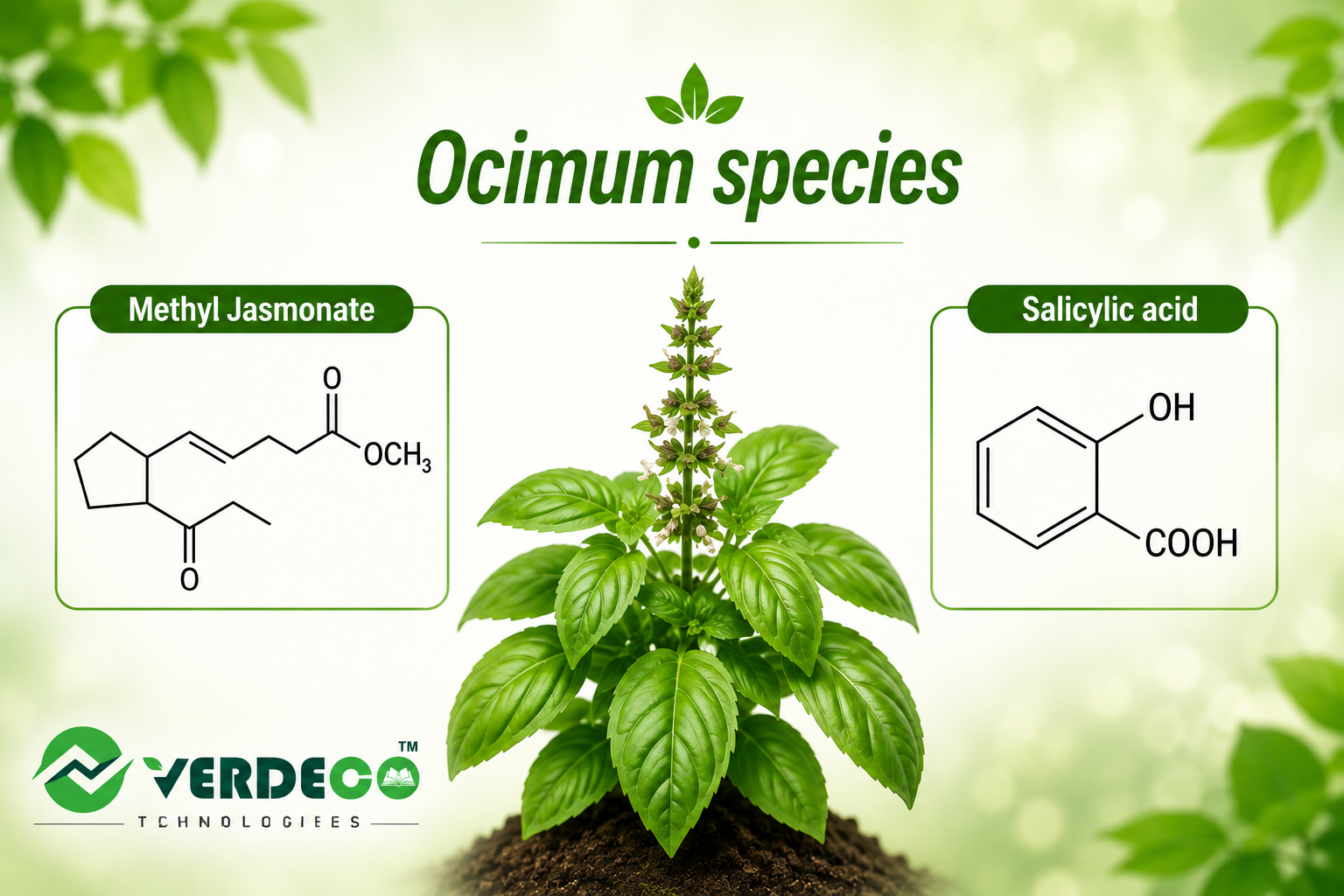
Ocimum species, commonly known as basil, are economically and medicinally significant aromatic herbs belonging to the family Lamiaceae. They are widely recognized for their rich phytochemical profiles, encompassing potent antioxidant compounds, phenolics, flavonoids, and essential oils with well-documented pharmaceutical and nutraceutical value. Despite their therapeutic potential, the enhancement of secondary metabolite accumulation in Ocimum species through safe and sustainable agrochemical strategies remains insufficiently explored. This study investigated the effects of two well-known signal molecule elicitors, methyl jasmonate (MeJA) and salicylic acid (SA) on the morphological characteristics and biochemical composition of four Ocimum species: O. basilicum (sweet basil), O. sanctum (holy basil), Lemon basil, and Cinnamon basil. Experiments were conducted under controlled greenhouse conditions. Seeds were sown in seedling trays at one seed per cell and maintained for 40 days under natural light and ventilation. Seedlings with four fully expanded leaves were transplanted into pots and treated with MeJA at 1 µM and SA at concentrations of 0.5, 1.0, and 1.5 mM. Results revealed that elicitor application significantly enhanced both growth parameters and phytochemical production across all four Ocimum species relative to untreated controls. Treated plants exhibited elevated chlorophyll accumulation, increased antioxidant enzyme activities (SOD and POD), higher soluble protein content, and greater concentrations of phenolic compounds and flavonoids. These findings establish elicitor application as a promising and sustainable strategy for improving the medicinal, pharmaceutical, and nutraceutical value of Ocimum species through targeted stimulation of antioxidant defense mechanisms and secondary metabolite biosynthesis.
Downloads
References
Ahmad, P., Abdel Latef, A. A., Hashem, A., Abd_Allah, E. F., Gucel, S., & Tran, L.-S. P. (2021). Nitric oxide mitigates salt stress by regu-lating ion homeostasis, antioxidant system, and osmotic adjustment in plants. Plant Physiology and Biochemistry, 167, 449–458. https://doi.org/10.1016/j.plaphy.2021.08.020
Chutimanukul, P., Theerakulpisut, P., & Kanawapee, N. (2025). Effects of methyl jasmonate on phy-tochemical accumulation and antioxidant activi-ty in basil (Ocimum basilicum L.). Industrial Crops and Products, 214, 118945. https://doi.org/10.1016/j.indcrop.2024.118945
Hasanuzzaman, M., Bhuyan, M. H. M. B., Zulfiqar, F., Raza, A., Mohsin, S. M., Al Mahmud, J., Fujita, M., & Fotopoulos, V. (2020). Reactive oxygen species and antioxidant defense in plants under abiotic stress: Revisiting the crucial role of a uni-versal defense regulator. Antioxidants, 9(8), 681. https://doi.org/10.3390/antiox9080681
Ivanova, T., Georgiev, V., & Pavlov, A. (2023). Mor-phological and phytochemical characterization of sweet basil (Ocimum basilicum L.). Plants, 12(5), 1048. https://doi.org/10.3390/plants12051048
Jain, R., Singh, P., Abdelkader, M., & Boulila, W. (2024). Efficient lung cancer detection using computational intelligence and ensemble learn-ing. PLoS ONE, 19(9), e0310882. https://doi.org/10.1371/journal.pone.0310882
Jermini, M., Mancini, S., & Giusti, F. (2019). Phyto-chemicals and antioxidant properties of medici-nal herbs. Food Chemistry, 289, 125–134. https://doi.org/10.1016/j.foochem.2019.03.041
Khan, M. I. R., Jalil, S. U., Chopra, P., Chhillar, H., Fer-rante, A., Khan, N. A., & Ansari, M. I. (2021). Role of GABA in plant growth, development and senescence. Plant Gene, 26, 100283. https://doi.org/10.1016/j.plgene.2021.100283
Majdi, C., Pereira, C., Dias, M. I., Calhelha, R. C., Alves, M. J., Rhourri-Frih, B., Charrouf, Z., Bar-ros, L., Amaral, J. S., & Ferreira, I. C. F. R. (2020). Phytochemical characterization and bioactive properties of cinnamon basil (Ocimum basili-cum cv. ‘Cinnamon’) and lemon basil (Ocimum × citriodorum). Antioxidants, 9(5), 369. https://doi.org/10.3390/antiox9050369
Olennikov, D. N. (2025). Salicylic acid-mediated en-hancement of antioxidant metabolites in me-dicinal plants. Biochemistry and Systematic Ecology, 118, 104622. https://doi.org/10.1016/j.bse.2025.104622
Paulus, D., Valmorbida, R., & Toffoli, E. (2019). Lem-on basil (Ocimum × citriodorum): Agronomic and phytochemical importance. Horticultura Brasileira, 37(3), 241–248. https://doi.org/10.1590/S0102-053620190301
Riaz, M., Rahman, M. U., Zahir, Z. A., Kamran, M., Mehmood, S., & Arif, M. S. (2021). Elicitor-induced enhancement of secondary metabo-lites in medicinal plants: A review of mecha-nisms and applications. Industrial Crops and Products, 168, 113614. https://doi.org/10.1016/j.indcrop.2021.113614
Raza, A., Tabassum, J., Fakhar, A. Z., Sharif, R., Chen, H., Zhang, C., Ju, L., Fotopoulos, V., Siddique, K. H. M., Singh, R. K., & others. (2022). Smart re-programing of plants against salinity stress using modern biotechnological tools. Critical Reviews in Biotechnology, 42(8), 1157–1182.
Rezaie, R., Farhoosh, R., & Sharif, A. (2022). Antioxi-dant activity of Ocimum species in different in vitro assay systems. Food Bioscience, 48, 101782. https://doi.org/10.1016/j.fbio.2022.101782
Shahrajabian, M. H., Sun, W., & Cheng, Q. (2020). Chemical components and pharmacological benefits of basil (Ocimum basilicum): A review. International Journal of Food Properties, 23(1), 1961–1970.
Ye, J., Wang, H., & Liu, Z. (2025). Exogenous methyl jasmonate enhances flavonoid biosynthesis and antioxidant activity in medicinal plants. Sci-entia Horticulturae, 337, 113456.
Downloads
Published
Issue
Section
License
Copyright (c) 2026 Muntha Attaria, Muhammad Umair, Zahoor Ahmad Sajid (Author)

This work is licensed under a Creative Commons Attribution 4.0 International License.